
The Best Dive Shop In Cozumel, Mexico!
Indeed, scuba diving trips in Cozumel is all about drifting effortlessly across the magnificent reefs like Palancar which surround our island. Get VIP service from the friendliest, most experienced, knowledgeable and simply one of the best Scuba dive shops in Cozumel, Mexico. At last, you can dive in paradise when you are scuba diving in Cozumel with Salty Endeavors!
Cozumel Scuba Diving – Get Salty!
We are Cozumel’s best scuba diving shop. Salty Endeavors is a premiere Cozumel dive shop which prides their selves on their passion for scuba diving. Our goal is to provide you with an exceptionally high level of customer satisfaction. We are passionate about Cozumel scuba diving and we want to pass our love, enthusiasm, and knowledge for the sport unto our guests.
All of our staff share a genuine love for the ocean and it’s animals, and as a result you will get to experience this firsthand. In our professional lives we have captive bred marine fish, managed reef restoration coral farm facilities in both greenhouses and in situ. Additionally, we have taught locals how to scuba properly and collect sustainable amounts. – all on a volunteer basis because of our love for the reef!
More importantly, we also love to share our love of the ocean with everyone! Accordingly, all our staff have many years work experience in not only Cozumel diving, but the scuba diving industry worldwide. Salty Endeavors’ six staff instructors combine to have taught more than 3000 people how to enjoy diving. In fact, to date have we enjoyed over 40,000 dives ourselves!
We are Passionate about Cozumel Diving
Our passion and enthusiasm for Cozumel scuba diving is infectious. The instructing and tutoring is unparalleled. As a part of this, our appetite for more knowledge cannot be quenched. For these reasons, it is our desire to share this with anyone searching for an unforgettable scuba diving experience. To begin your underwater Cozumel diving experience, contact us today!
Key Reasons to Dive with Salty Endeavors
Small Groups
~ Our boats hold a maximum of 6 or 8 divers plus staff (larger boats available upon request).
~ Ensures VIP service and attention from our dive team.
Fast & Fully Sun-Shaded Boats
~ Shorter boats rides! Morning boats return in time for lunch at your resort or downtown. Or enjoy a relaxed morning and get 2-tanks in after lunch.
~ Stay hidden from the sun at all times.
Pier pick up
~ Any pier of the island our boat will come to you.
~ Over 30 piers means there is one nearby.
Authorized Marine Park Permits / Operator
~ CONAMP permits on each of our boats means our boats are safety compliant, insured, and regularly inspected.
~ 106 peso per diver per day is paid towards conservation efforts (already included in your daily fee with us) protecting the best dive sites in Cozumel.
A Dive Team that is unmatched in Cozumel
Experienced Divermasters
~ Isidro 30 years Cozumel Divemaster 20,000+ dives
~ Francisco 25 years Cozmel Divemaster 20,000+ dives
~ Martin 30 years Cozumel Divemaster 18,000+ dives
~ Eduardo 5 years Cozumel Divemaster 4,000+ dives
Expert Instruction
~ From first-time divers all the way through to Instructor level training.
~ Henry is the only SSI Platinum Pro 5000 Instructor Trainer in the Mexican Caribbean. 2000+ graduates.
~ Francisco 20 years instructor, 2,000+ graduates.
~ Jose, Guillermo, Shamik all Advanced Instructor rating or higher.
Experienced Captains
~ Having a Captain that knows the reefs and is in-tune with the Dive Leader is paramount to your experince.
~ Victor has 30 years experience on the boats of Cozumel.
~ Chispa has 20 years experience on the boats of Cozumel.
~ Elias has 25 years experience on th eboats of Cozumel.
Your Beginner Scuba Dive Shop in Cozumel
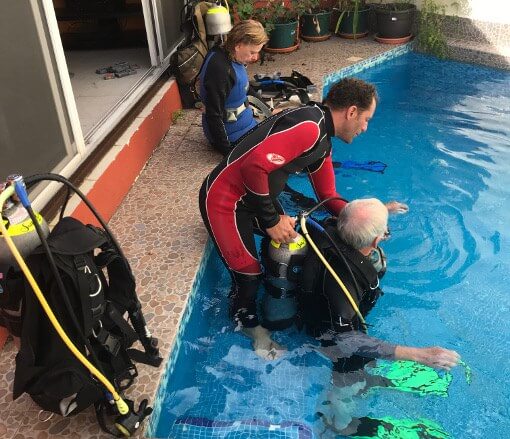
As the best scuba dive shop in Cozumel, Mexico, we offer PADI and SSI dive certifications for the beginner scuba diving excursion to the advanced diver and professional. Our dive center in Cozumel features a waterfront location unlike anyne other shop. We are 100% solar powered and only steps from our boat. Additionally, we have a private pool for instruction – a luxury on Cozumel! You won’t be in a resort pool with 20 other students plus swimming/playing children when you learn with us. Our pool location is ideal for the new students to learn in a calm, peaceful atmosphere conducive to a proper educational experience.
If you’ve never been SCUBA diving previously we can start you immediately. In fact, in our Discover SCUBA program we can get you enjoying the underwater world today! Alternatively, for those looking to become PADI certified, we offer online e-Learning options. In this regard, online learning is a holiday time saver. Specifically it allows you to complete the classroom portion before you arrive. Notably, this saves you one day of training time. Furthermore, you can begin reading your textbook today without paying a deposit!
On the subject of Advanced Dive Training, we start advanced-level training classes nearly every day. I mean with programs from Advanced Open Water to Divemaster and everything in between, we are ready to go! In all honesty we feel every diver should be Rescue trained and EANx certified. But that isn’t to say our favorite classes to teach are not Navigation, Buoyancy, and Wreck. Moreover, all classes available with online e-Learning!
Cozumel scuba diving is the ideal way to learn or continuing learning diving!
Please note we now also training for all SSI Freediving classes!
If you are interested in booking Cozumel scuba diving with our highly trained staff please send us an email and let us know your wishes. Or you can directly reach us by phone if you have immediate needs. We have disclosed the numbers below-
Cozumel Diving Team
That’s the nickname we’ve given ourselves as we truly are a team. The Salty Endeavors dive shop has hand-picked it’s team members to ensure you are getting the very best scuba diving experience possible in Cozumel, Mexico. Henry has the biology background, Isi, Martin, and Pancho brings nearly 30 years of diving the Cozumel Marine Park waters – talk about experience! Our instructors combine for over 4000 graduates and nearly 80,000 dives! Combined with Captains Victor and Chispa, we know we’re bringing you the best possible foundation for an unforgettable diving vacation.
Our Dive Company
We actually dragged our dive shop to Cozumel all the way from Chicago. It made a heck of a story which I no doubt will share in the blog someday. Hence, our dive shop is a 28 foot long cargo trailer. What is more, Henry personally custom designed and built to his specifications. It is 100% solar powered and not just packed full of our toys, but similarly ready to entertain with tables, chairs, and a sun awning. It’s a great place to watch the sun set as we chat diving on Palancar reef over a few cold ones.
Rental Equipment
Above all, your safety depends not only on our dive crew, but also upon the rental equipment. This is why all our quality equipment has been hand selected by Henry, and in some cases custom built per his specifications. More importantly, we want you to have confidence and comfort in the rental equipment from Salty Endeavors. Rear-inflate, weight-integrated jackets, piston-balanced first stage regulators, swivel-assisted second stage regulators, quick-glide straps with secure-lock buckles, double tank bands, integrated trim weight pockets, open-heel fins with neoprene booties.
The Blog
We’ve created our blog to help share our story and passion for diving. We utilize it on many fronts – all our staff are asked to publish their daily dive logs for you. In addition, you can look forward to Henry getting verbose on animal biology. Furthermore, Aries loves to talk about equipment and training techniques. Finally, Ray is our Cozumel diving historian and loves to tell you about his best times in Cozumel scuba. In addition to the many photos, videos and more ideas forthcoming!
Find Us On Your Favorite Social Media
Proving we are the Best Cozumel Dive Shop every day!
Salty Endeavors joined TripAdvisor in December of 2016. In consequence, when we joined, as expected, we were listed dead last. At that time I think there was around 290 Outdoor Activity providers. I must say, I hated that look for us! We knew we did not belong at the bottom of Cozumel scuba diving operators. In spite of this, 18 months later we breached the Top 10 of what is now over 300 providers! Even more, we are still climbing! Come scuba diving on Cozumel with Salty Endeavors and you’ll know you are diving with one of the best dive shops in Cozumel!
Book Your Cozumel scuba diving and snorkelling adventures with Salty Endeavours today!


Tell me more about diving in Cozumel!
To begin, Cozumel is a small island of the east coast of Mexico. It lies roughly 12 miles off the coast of Playa del Carmen, and approximately 50 miles south of the tip of the Yucatan Peninsula. The island itself is about 10 miles wide, but more importantly it is also 30 miles long. And for you and me that means 30 miles of reef to scuba dive!
The best part about scuba diving in Cozumel the diversity of diving and dive sites. Cozumel diving offers our divers the opportunity to dive walls with floors in excess of 1000 feet, surround yourselves in coral pinnacles, encase themselves inside caves and canyons, drift quickly over carpet reefs, or slowly creep of sand beds and grass fields looking for the small stuff. It offers all of this in crystal clear waters averaging 100 feet / 30 meters of visibility as an average day!
Cozumel scuba diving offers wall dives such as the famous Santa Rosa Wall, Maracaibo, Barracuda, and Punta Tunich. The steep vertical drop of the walls to depths well beyond our limits is so impressive it is only rivaled by the colors and sizes of the coral formations. Santa Rosa offers a fantastic mix of diving – from the incredible wall itself, plus toss in a few swim throughs, the fantastic cut-outs at the back half, and then of course finishing up in the shallows with the rays and schools of Jacks and patch reef corals. It’s no wonder its among the most talked about dive worldwide!
Learn More About Salty Endeavors! Talk to our representatives.


In contrast, the wall dives of Maracaibo, Barracuda, and Punta Tunich all exhibit the trait which Cozumel diving is known for – drift diving! While Maracaibo and Barracuda represent the far southern and northern reefs, Punta Tunish sits right in the middle. Tunich features lush coral growth and impressive numbers of fish, including the cave of 1 million fish! Maracaibo is heart-pounding wall dive shaped like an L titled 45 degrees inward creating an overhang that gathers swimming sharks! …And Barracuda, well, you just be ready to enjoy the flight of a lifetime as you soar over the wall feeling like Superman!
Speaking of formations, Palancar reef is world renowned for its epic coral formations. Not quite classified as a wall dive, Palancar still offers impressive drop-offs, but the focus is more upon the canyons, pinnacles, swim throughs, and crevasses. As you swim through the coral formations your mind cannot help but wonder about the millions of years it took to make such a unique reef-scape. Corals growing upon corals for eons shaped by the ebb and flow of Cozumel currents.
And then there is Colombia reef. It can get classified as wall dive – we call it Colombia Deep. But Colombia is more than a wall dive. I label it kind of like the father of Palancar, or what Palancar wants to be in another million years. It’s everything that Palancar is, but bigger and more impressive and with more fish. It is a little deeper than Palancar, so it can begin to challenge divers looking for more experiences.


Toss in the middle reefs like Dahlilah, French, Yucab, and Tormetos and you have some excellent slow drifts which are excellent all-around reefs for diving. All of the middle reefs feature a feef depth of 30 feet / 10 meters at the top, which is bathed constantly in sun and current making for a lush coral garden. The sites mostly drop to 60 feet on average, making them fantastic sites for divers of all skill levels.
Cozumel Scuba Diving Packages & Pricing
Salty Endeavors is ready to help tailor a dive vacation package built specifically for you. If you simply want to book a day or two of diving, we are ready to assist. However, we are also able to book for you travel packages that include door door-to-door services with valet cars or rental vehicles, hotel, resort, or villa stays, plus land excursions – and of course diving with us!
We have partnered with several vacation rentals in order to provide you with a selection of properties in all price ranges. We offer a private apartment for two people starting at $20/night, up to sprawling oceanfront villas, and everything in between. Some of our most popular choices are Hotel Cozumel and Casa Mexicana due to the locality of being walking distance from everything downtown. Other guests love the seclusion of a condo in Residencias Reef. Popular resorts like Occidental, Iberostar, Secrets and Palace are also included. No matter your preference, we can help! For complete details of the properties we have partnered with, please check our Cozumel All Inclusive page, or simply contact us directly.
Beyond your lodging, we are ready to help you burn off your nitrogen loads by assisting with top-side activities. We have contacts which operate may various private tours around Cozumel, plus of course we can reach out to any existing company and make arrangements for you. One of our favorite land day trips to partake in is the Cozumel Turtle Hatching program. If you are here in the spring you can join in the nesting season where you look for turtles coming ashore to lay eggs. Alternatively, if you are here in the fall you can assist with the hatching! The hatching is by far the best part as you get to hold, play, and help hours-old baby turtles. This is but one idea – ask us for more!
Of course we cannot forget the diving! Any of the land-based trips are merely an add-on to us helping you find your best dive package in Cozumel. It is important to note we do not own or operate any of these land excursions – we just help you make these connections and reservations. Our focus is, of course, on the Cozumel diving and providing you the very best diving experience possible. So when you add any of the land excursions we can vouch for, combined with our diving vacations, you now have yourself the complete Cozumel dive package!


We are on a Cozumel cruise, can we dive with Salty Endeavors?
Absolutely! Unlike many dive shops in Cozumel, Salty Endeavors warmly welcomes our divers arriving to the Cozumel ports via a cruise ship. Royal Carribean, Carinval, and Norwegian Cruise Lines customers are all welcome. We fully understand your desire to get away from the over-priced cattle-boat tour excursions provided by your cruise tour operators. Joining us for a relaxing day of scuba diving Palancar reef on our VIP fast boats is the perfect afternoon escape.
If you are arriving to Cozumel into the ports of Punta Langosta, International Pier, or Puerta Maya, we can help you spend your day in the best Cozumel scuba diving! We offer several options for you to board our boat and spend a relaxing morning or afternoon submerged on the reefs inside the Cozumel Marine Park. On our fast boat we’ll get you diving and back with time to spare so you can still shop or sight see on Cozumel before departure.
There are a few bits of information that we need from you to ensure we can provide our services. Additionally, we provide full details of what we can cannot provide to our cruise ship divers. We ask that all our divers arriving to a Cozumel port on a cruise to have a read over our Cozumel cruise diver information page and provide us with the necessary information to fully assist you.

Things to do in Cozumel
There are so many other things to do in Cozumel that my list can be near endless. Thankfully for you, I’m slowly compiling my own list of things to do in Cozumel other than scuba diving. As I like to tell my divers looking for stuff to do, Cozumel sees roughly 12 million tourist visitors yearly. Our entire economy lives and dies off of tourism. If a tourist wants to do something, there is a very high likelihood that we have it available to you on this island. Contact us and let us know what it is you want to do apart from visiting our best dive shops in Cozumel!

Find Us in Cozumel
Salty Endeavors Dive Shop
Prefer to call us?
Call from USA (312) 757 - 6167
From Mexico dial 987 - 119 - 3731
WhatsApp Free International text and calling +521 - 987 - 119 - 3731
Cozumel Vacation Packages
All-Inclusive Resorts
Cozumel Hotels
Best Value
Find Us
Classroom FAQ
Diving FAQ
Travel FAQ

Wouldn't you rather be Salty?


